
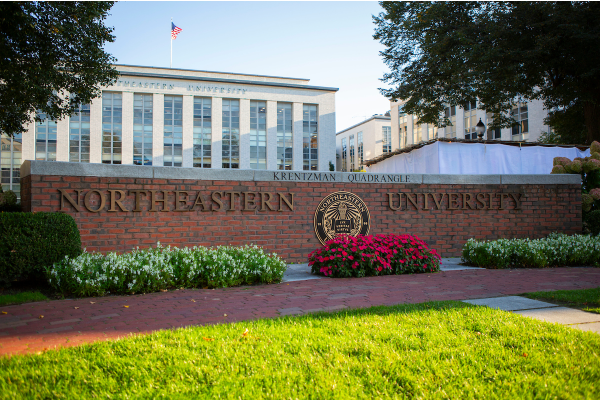
Northeastern University is a private research institution built around a distinctive idea: learning cycles between classroom and industry. Founded in 1898, it turned co-op (six-month, full-time jobs tied to your major) into a signature model that now spans Boston, Oakland, London, and additional global sites. Students rotate through rigorous coursework and paid professional placements, often graduating with a résumé that looks more like an early-career portfolio than an internship list. The result is practical, research-driven education in an urban setting where labs, startups, hospitals, and media are as close as the Green Line.
Overview
The Charles River/Back Bay footprint is urban and linear, with residence halls, classrooms, studios, and research centers strung through a walkable campus grid that blends into the city. Co-op shapes the academic calendar: Northeastern runs three full semesters (fall, spring, summer), and students interleave terms in class with six-month co-ops—tuition is charged only when you’re taking classes, not while on co-op. That pattern, plus sites in Oakland and abroad, makes it normal to study in Boston, work in London, and finish in California. It’s a pragmatic culture: maker spaces, research labs, and employer projects sit alongside studio courses and capstones.
Academics and Majors
Northeastern organizes programs across engineering, computing, business, health sciences, arts, media, design, social sciences, and the sciences. The College of Engineering and Khoury College of Computer Sciences are perennial draws for software, data, AI, bioengineering, and cybersecurity. Business programs in the D’Amore-McKim School emphasize analytics, supply chain, entrepreneurship, and corporate partnerships. Health and life sciences lean on Boston’s hospital and biotech ecosystems, while media and design take advantage of the city’s newsroom and creative networks. Co-op employers range from global firms to early-stage startups; many students complete two or three co-ops before graduation, often with increasing responsibility.
Campus Life
Life here is city-forward: residence halls and dining are woven through a neighborhood of parks, cafés, and MBTA stops. Clubs span professional societies, cultural orgs, media, design/build, service, and performing arts. Varsity, club, and intramural sports keep the facilities busy, and the city handles the rest—internships during the semester, concerts within a few stops, and weekend trains to Cambridge, the Seaport, or the North Shore. Students who cycle through co-op find their social circles expand with each work site, which is part of the draw.
Admissions: What It Takes to Get In
Admission is selective and holistic. Northeastern remains test-optional; applicants choose whether to submit SAT/ACT, and students who do not submit scores are not disadvantaged (English proficiency testing rules still apply for non-native speakers). Deadlines are later than many peers and vary by decision plan: Early Decision I (Nov 15), Early Action (Dec 1), Early Decision II (Jan 15), and Regular Decision (Feb 15). The university also runs multiple first-year entry pathways (e.g., Boston, Oakland, and specific global programs). Always follow the current Northeastern page for materials, plan details, and CSS/FAFSA timing.
Tuition, Scholarships, and Financial Aid (2025–26)
For 2025–26, the catalog lists $33,995 per full semester in undergraduate tuition (that’s $67,990 for two full semesters), with a published per-credit rate of $2,125 for overload or reduced-load scenarios. The NU-Unlimited meal plan shows $4,450 per semester; the page lists an estimated median housing rate of about $5,680 per semester (actuals vary by building and room type). Typical Boston campus fees include an Undergraduate Student Fee ($362.50/semester) plus smaller activity, student center, and recreation fees; the Student Health Plan is $2,849 annually unless you waive with comparable coverage. Northeastern notes an allowance of about $2,800/year for books/personal/transport when estimating total cost. (Co-op terms don’t bill tuition but you still budget housing/food if you remain in university housing.)
Financial aid runs through Student Financial Services with a mix of institutional scholarships, need-based grants, Federal Work-Study, and loans; merit awards are competitive and tied to the application review. Use Northeastern’s cost/aid hub and net price resources to model two scenarios—two semesters in class vs. a year with a co-op term—since billed tuition changes with your pattern of attendance. For off-campus planning, the Boston–Cambridge–Newton CPI was down 0.3% over the two months ending July 2025 and up 3.2% year-over-year, a useful signal when adjusting rent and food assumptions.
Conclusion
Northeastern’s value proposition is straightforward: you study, you go to work in your field, then you return to class with clearer questions and better instincts. That rhythm compounds. By the second or third co-op, many students have built portfolios that read like early-career résumés, with references who know their day-to-day work. In a city with dense tech, biotech, hospitals, media, and startups, those cycles translate into practical skills and a network that sticks. Costs make more sense once you view them by semester and pattern. In 2025–26, tuition lists at $33,995 per semester; add typical housing, meal plan, campus fees, and (unless waived) the $2,849 health plan to approximate billed charges. Then create a second budget for a co-op term: tuition drops off while living costs continue, and paid co-op earnings can offset some expenses. Modeling both paths gives you a truer picture than a single annual total.